California

Sea wrack, the sign informed us, is a fetid gunk that accretes along the beaches of Big Sur. Left by the tides, these ribbonlike seagrass clumps provide valuable habitat for kelp flies, flightless beetles and skittering crustaceans that in turn sustain populations of native shorebirds. ‘Sea wrath,’ my mind echoed, misremembering.
With a gap between graduate school and new jobs starting, my longtime friend and I found ourselves exploring California’s Andrew Molera State Park, so named after the gentleman who introduced artichokes to the state in the 1800s (it must have been easier to get things named after you back then). The park is perched somewhere in the northern reaches of Big Sur, an area of coastline whose boundaries remain amorphous to me. What I do know is that where the rest of California bakes in triple digit heat, Big Sur is ringed by mountains and receives constant breezes that keep temperatures somewhere in the 60s year round.
Much as my friend and I would have preferred to keep our travel confined to this eddy of maritime air, California’s iconic Pacific Coast Highway was closed for landslide repairs. Instead, we zigzagged through alfalfa fields and Space Force bases thirty miles inland, returning to the coast to camp at night. The ocean taunted us upon arrival by hiding under an unshakeable fog bank. The hotter and dryer it is inland, the foggier it gets along the coast. “The best time to come here is October,” a park ranger informed us. “Heading to Las Vegas tomorrow—supposed to be 118!”
When we ventured out on our first hike, another man emerged suddenly out of the fog to ask if we had seen The Whale. Our eyes darted eagerly out to sea before confusedly following his finger pointing to a nearby cove. A smallish, whale-ish mass laid beached on the sand, some two weeks removed from its seagoing days. Whale wrack, I reasoned, must make an excellent food source for the right bird.
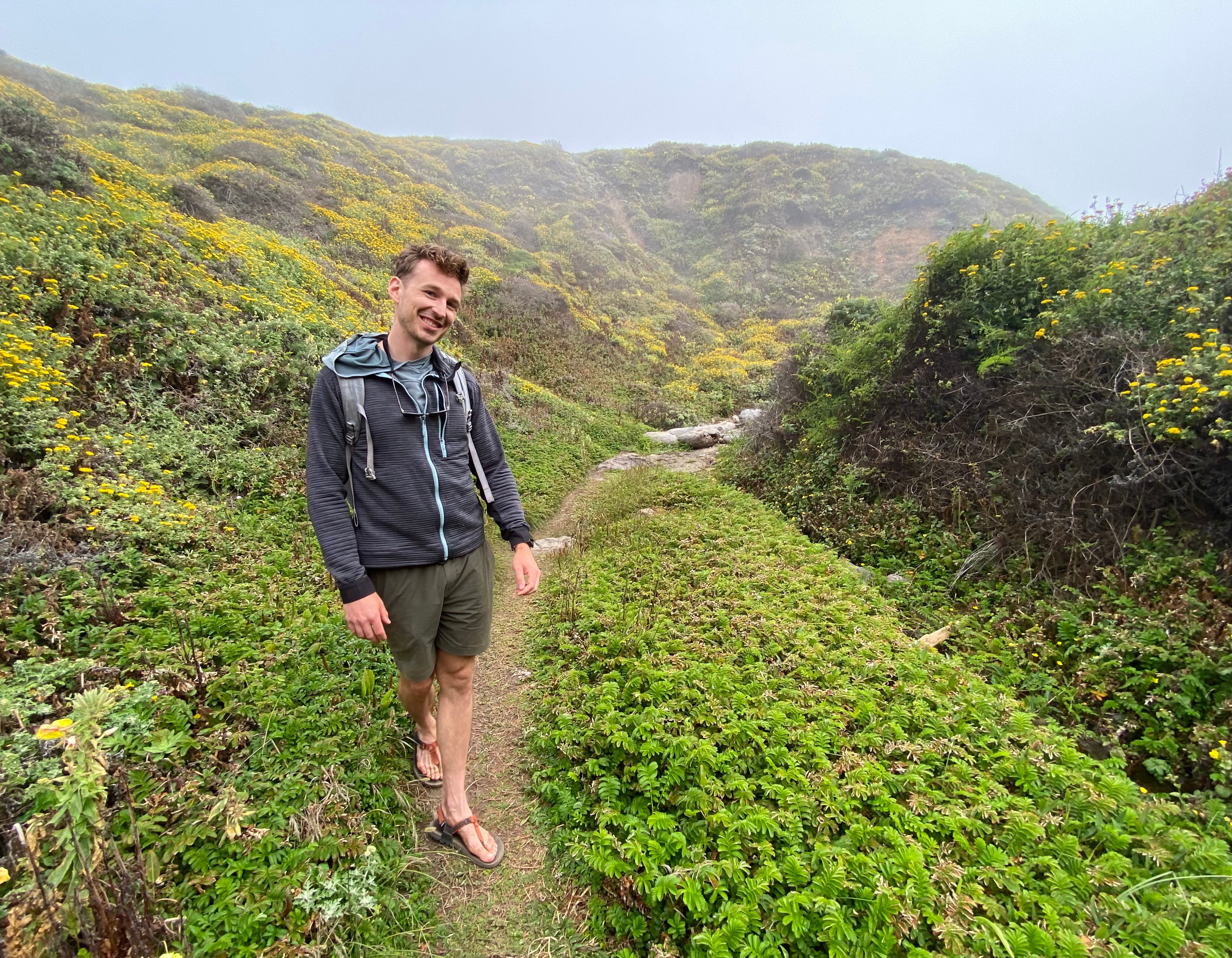
Not to be deterred, my friend and set off on our next hike towards some scrubby bluffs where we might be able to view the ocean from beneath its foggy curtain. The trail crackled with purple succulents and golden wildflowers. Rabbits and skinks darted hurriedly as we approached, while the fog parted and resealed itself to maintain a roiling sphere of visibility around us hikers. Picking our way down the trail, we followed an arroyo downhill to a beach that shone pink with mineral deposits. Flanking the beach were cavernous walls of ancient coral. When we paused there, the sound of the waves pitched up and blurred into a resonant hum.
Plunging into the ocean, I saw the waves and fog for the first time as tandem iterations of the same fluid motif. They teemed gracefully, offering the same statements, counter-statements and resolutions, albeit at different tempos, in different media. Just as thrillingly, each rebounding wave dissolved into a thousand smaller waves that deposited sand grands in intricate arrangements unmistakably mirroring the plants’ stem-and-branch structures just up the hillside. Shutting my eyes, I saw images materializing, too, as wavelike droplets upon the clear basin of Mind. I smiled inwardly, amused and a little embarrassed at my own grandiosity. I scribbled words in my iPhone Notes app to remember for later: “Dissolution Reconstitution,” they read.
Our surf instructor three days prior had effortlessly read these waves, sensing preternaturally when swells would break early or at the wrong angle across our supersized beginner boards. She would yell to paddle out further into the safe zone, somehow appearing alongside us as though willed there by the waves. I felt pride then at insisting we head out despite the heavy surf, as well as a familiar pang of jealousy in the company of those so obviously at ease in such an environment. “This is the warmest water I’ve felt out here in ten years of surfing this beach!” she had laughed. “All last year this water was filled with animals nobody had ever seen before.” I felt another familiar stab, this time of anxious dread. Remembering these words on the pink beach, I pictured warm blobs of water drowning the kelp forests that had not already been eviscerated by sea urchins. I grieved these beaches’ brokenness, and was grateful for them.
Drifting back towards camp, my friend and I immersed our legs in the warm, pillowy water of a small river crossing. The water wrapped behind us like the waves in an old window pane, disturbing its otherwise textureless surface. “We’re wearing the water,” I pointed out. We massaged our feet in the gravel, looking for fish, finding none. I knew we had a sketchpad back at camp. Pondering how best to capture the essence of this area, I thought of a passage from an essay I had read months earlier:
I am using the word [‘form’] in a simpler sense, which it has when you say, on a foggy night, that you see dimly moving forms in the mist; one of them emerges clearly, and is the form of a man. The trees are gigantic forms; the rills of rain trace sinuous forms on the window pane. The rills are not fixed things; they are forms of motion. When you watch gnats weaving in the air, or flocks of birds wheeling overhead, you see dynamic forms - forms made by motion. It is in this sense of an apparition given to our perception, that a work of art is a form…But it is always a perceptible, self-identical whole; like a natural being, it has a character of organic unity, self-sufficiency, individual reality…
Human feeling is a fabric, not a vague mass. It has an intricate dynamic pattern, possible combinations and new emergent phenomena. It is a pattern of organically interdependent and interdetermined tensions and resolutions; a pattern of almost infinitely complex activation and cadence. To it belongs the whole gamut of our sensibility, the sense of straining thought, all mental attitude and motor set. Those are the deeper reaches that underlie the surface waves of our emotion, and make human life a life of feeling instead of an unconscious metabolic existence interrupted by feelings. It is, I think, this dynamic pattern that finds its formal expression in the arts… Art’s relation to feeling is a rather special one that we cannot undertake to analyze here; in effect, the feeling it expresses appears to be directly given with it - as the sense of a true metaphor, or the value of a religious myth - and is not separable from its expression. We speak of the feeling of, or the feeling in, a work of art, not the feeling it means.
If we are to believe this passage, it is no tragedy that art does not faithfully reproduce reality as such. It presents, or contains, its own reality as a carrier of subjective experience. The words left on this page are are a hopelessly inadequate stand-in for the patterns of fluid energy transfer that made themselves known on the beach that afternoon: that Life principle, Bio-logy. But these words do act as a visual stimulus for imaginative perception, as a sort of hallucinatory prompt shared between author and reader. My thoughts, feelings, recollections: yours now too.